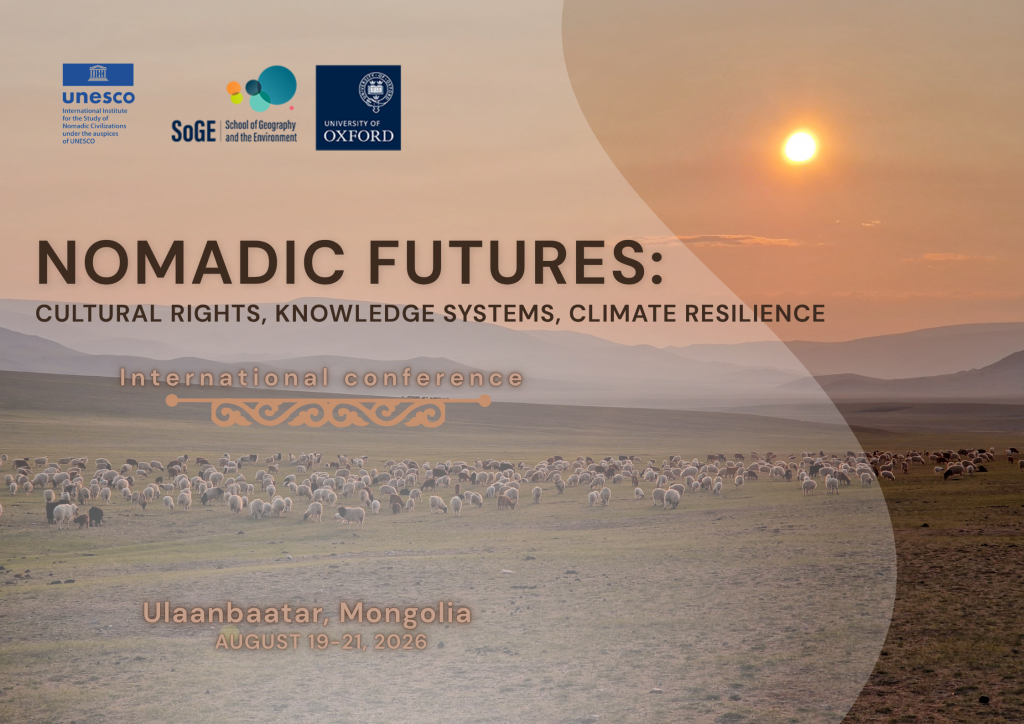
Nomadic Futures: Cultural Rights, Knowledge Systems, Climate Resilience
Conference dates: 19-21 August 2026, Ulaanbaatar, Mongolia
In-person participation is prioritised
Deadline for submission: 10 June 2026 (extended until 20 June 2026)
The International Institute for the Study of Nomadic Civilizations under the auspices of UNESCO (IISNC), in collaboration with partner institutions and networks, is organizing an international, interdisciplinary conference titled Nomadic Futures: Cultural Rights, Knowledge Systems, Climate Resilience, to be held on 19-21 August 2026. Coinciding with COP17 to the United Nations Convention to Combat Desertification (UNCCD) and the United Nations International Year of Rangelands and Pastoralists (IYRP), this conference will critically examine the status of cultural rights and political recognition for mobile pastoralists and nomadic peoples. Cultural rights, ways of knowing and climate resilience will be explored as integrated elements rather than separate spheres.
This conference responds directly to the recommendations in the 2024 report on the Situation of Mobile Indigenous Peopleswritten by the United Nations Special Rapporteur on the Rights of Indigenous Peoples by creating an interdisciplinary platform to examine the legal recognition, cultural rights, mobility, land tenure, and political participation of mobile Indigenous Peoples. In particular, the conference seeks to advance dialogue around the report’s calls for stronger protections for customary territorial rights, transboundary mobility, culturally grounded education, free, prior and informed consent, and the recognition of mobile Indigenous Peoples’ ways of knowing and governance practices as essential to cultural survival. The conference, therefore, seeks to provide a platform for the discussion of rights-based approaches to mobility, cultural heritage, and climate resilience
The conference also engages with international developments that increasingly recognize mobility as a culturally embedded practice and form of intangible heritage constituted through complex ecological, social, and epistemological relations. UNESCO’s recognition of transhumance and pastoral mobility as Intangible Cultural Heritage reflects the significance of intergenerational knowledge transmission, seasonal movement, oral traditions, customary social institutions, and collective relationships to land in sustaining mobile lifeways across generations. Such developments provide an important conceptual and policy framework for understanding nomadic mobility not simply as an economic strategy or adaptive response, but as a culturally grounded way of knowing. Likewise, the conference also draws inspiration from the 2007 Fribourg Declaration on Cultural Rights, which emphasizes the indivisibility of cultural rights from dignity, identity, participation, memory, and collective ways of life.
Bringing together perspectives from anthropology, Indigenous studies, geography, environmental humanities, pastoral studies, political ecology, law, religious studies, development studies, and the arts, Nomadic Futures will create space for dialogue across academic, practitioner, government, herder, and civil society networks. The conference is particularly interested in conversations that critically address issues in cultural rights for mobile pastoralists and nomadic peoples, challenge equilibrium-based and sedentary frameworks of governance and development, address the right to collective cultural identity and self-determination for mobile pastoralist and nomadic peoples and examine how nomadic and pastoral worlds continue to generate alternative political, ethical, and ecological imaginaries, and developmental imaginaries.
Only papers and interventions with clearly articulated ties to the conference abstract will be accepted for presentation.
Possible themes include, but are not limited to:
•Cultural rights and pastoralist representation
•Rights-based approaches to pastoral governance
•Indigenous and pastoral knowledges
•Nomadic intellectual traditions and cosmologies
•Mobility, uncertainty, and non-equilibrium thinking
•Food sovereignty and multispecies relations
•Customary mobility rights and transboundary movement
•Oral traditions, memory, and intergenerational transmission of knowledge
•Gendered dimensions of pastoral mobility and knowledge systems
•Youth, education, and cultural continuity
•Land rights in the context of extractivism, conservation, and “green transition” projects
•Traditional ecological knowledge
•Spirituality, ritual, and sacred landscapes
•Artistic, poetic, and creative approaches to mobility and pastoral futures
The conference anticipates contributions from leading scholars and practitioners working on nomadic and pastoral worlds, including perspectives on mobility and uncertainty, relational ecologies, cultural rights, pastoral governance, mobile peoples’ways of knowing, and the politics of climate and conservation.
We welcome proposals for:
•Individual papers
•Panels
•Roundtables
•Films and multimedia presentations
•Artistic and performance-based contributions
Deadline for the abstract and biography: 10 June 2026
Abstract submission link: https://forms.gle/bBYVJ7FmpNV9xhAg9
Notification of acceptance: 22 June 2026
For inquiries, please contact with IISNC through secretariat@unesco-iisnc.com and ariell.ahearn@ouce.ox.ac.uk

No responses yet